Publication Details
Authors: Maria Victoria Serrano, Stéphanie Cottier, Lianzijun Wang, Sergio Moreira-Antepara, Anthony Nzessi, Zhiyu Liu, Byron H. Williams, Myeongwoo Lee, Roger Schneiter, Jun Liu
Journal: Genetics 229 (2): iyae202
Year: 2025
PMID: 39657262
Abstract
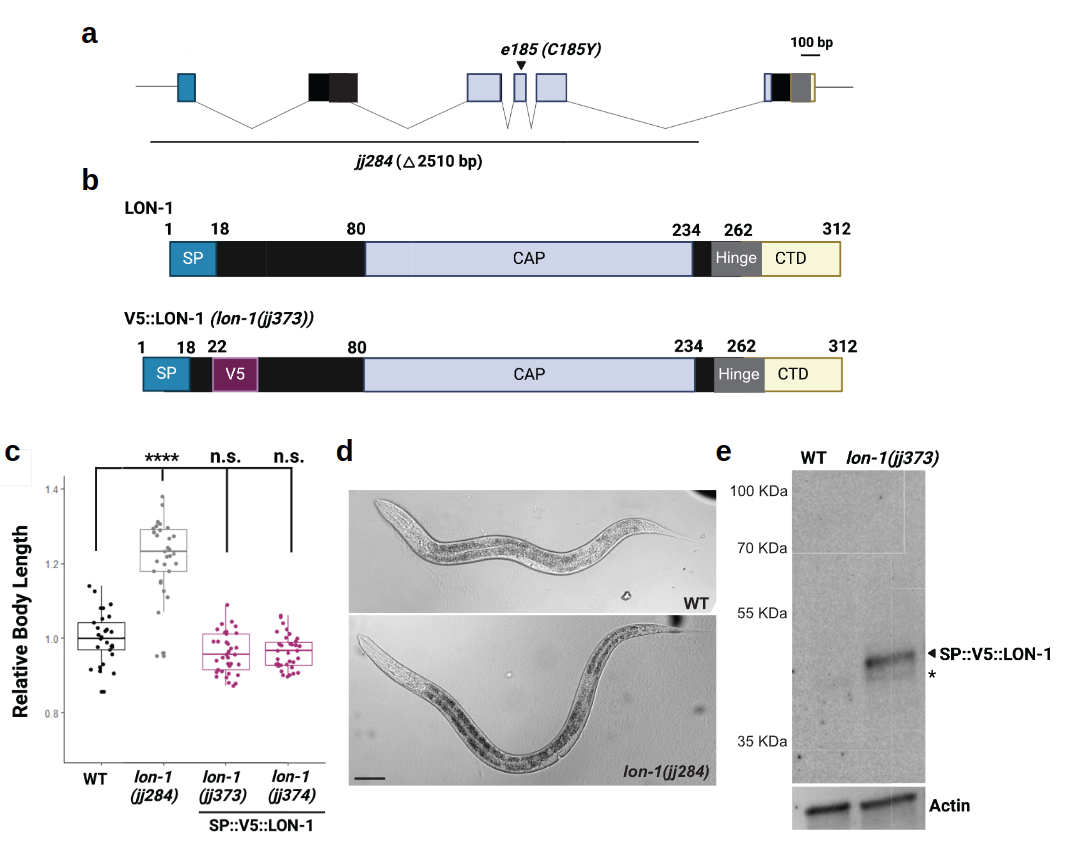
The CAP (cysteine-rich secretory proteins, antigen-5, and pathogenesis-related) family is broadly expressed across species. CAP proteins have roles from mammalian reproduction to plant immunity and often bind lipids. The C. elegans CAP protein LON-1 regulates body size and BMP signaling. LON-1 is secreted, containing a conserved CAP domain and an unstructured C-terminal region. The C-terminal domain was found dispensable, whereas conserved residues in the CAP domain were critical for LON-1 function in vivo. LON-1 binds sterol (but not fatty acid) in vitro, and the same residues required in vivo also mediate sterol binding. These findings link LON-1 function to sterol binding in regulating body size and BMP signaling.
Keywords
CAP domain, BMP signaling, sterol binding, body size, C. elegans
Citation
Serrano, M. V., Cottier, S., Wang, L., Moreira-Antepara, S., Nzessi, A., Liu, Z., Williams, B. H., Lee, M., Schneiter, R., & Liu, J. (2025). The Caenorhabditis elegans LON-1 protein requires its CAP domain for function in regulating body size and BMP signaling. Genetics, 229(2), iyae202. https://doi.org/10.1093/genetics/iyae202
Links
- 📄 Download PDF (Local copy)
- View Publication
- PubMed